
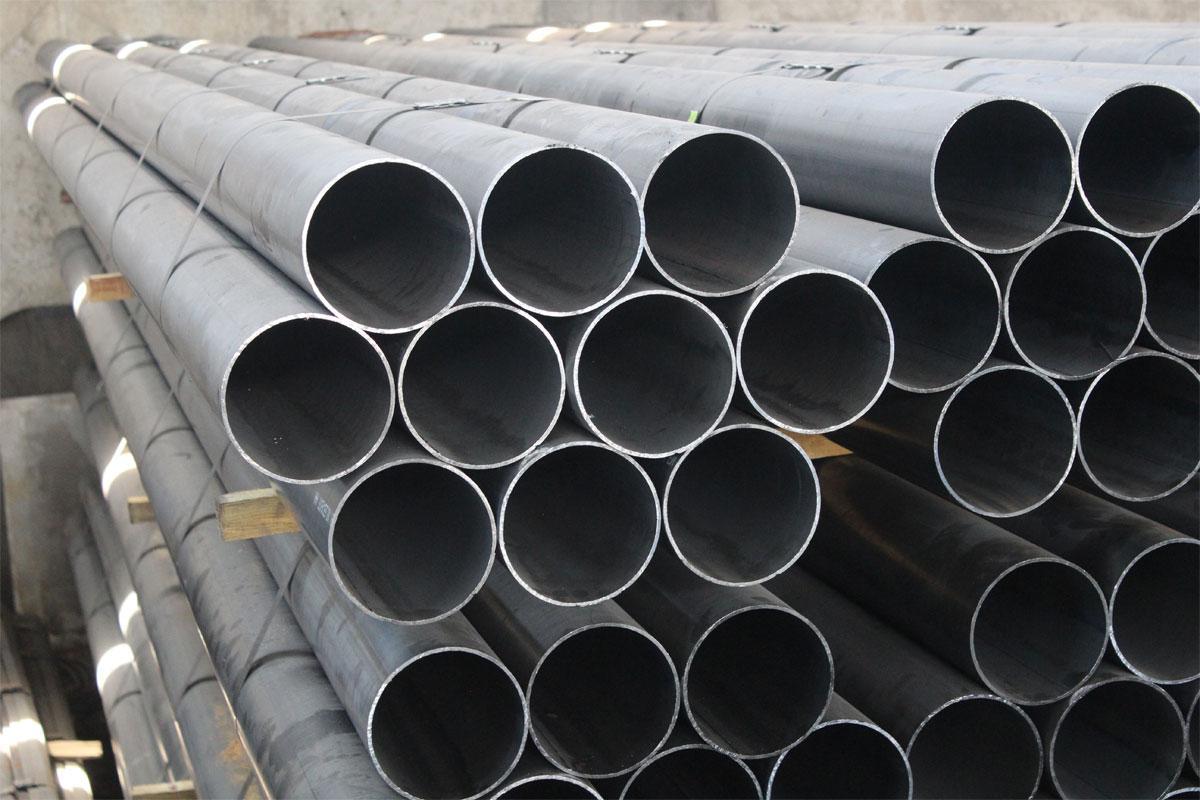
How exactly and from which workpieces is a cold-worked seamless pipe made? Why is it needed and how does it differ from electrowelded pipes in terms of operational features? What regulatory documents is the production subject to?
Let’s try to find answers together.
Features and scope
To begin with, we will find out why, by and large, seamless pipes are needed (see also the article “Transparent pipe: characteristics and materials”).
Alas, it is difficult for them to come up with the use of plumbing fixtures or any other home equipment when they do-it-yourself installation. The price of the products is too high, and the durability is obviously excessive for any reasonable purpose.
In short, they are in demand where extreme strength is needed (first of all, to break). Another development, much more inexpensive and technologically advanced – the production of welded pipes – has a significant drawback.
Regardless of all control methods, the seam will always be not a strong place: if the ultimate strength is exceeded, the pipeline will break just along its line.
To clarify: all electrically welded pipes should not be dumped in a non-specialized heap. the strength and quality of the seam vary greatly depending on the design chosen; so, high-frequency welding gives a poor level of weld quality when compared with electrode welding in argon environment.
Here are a couple of examples of applications for seamless pipes.
Pump and compressor pipelines used for gas condensate and oil pumping under high pressure.
Oil well casing strings.
Pipelines for maintaining in-situ pressure during the development of underground deposits.
Compressed gas cylinder walls.
Hydraulic cylinders.
By combining steel grade and wall thickness, it is possible to take pipes with devils that satisfy virtually any strength requirement.
Production development
Billets for production – the so-called conversion pipes, which are produced by the method of warm deformation from cylindrical blanks – rods. The rod is held in a furnace to a temperature at which the steel becomes plastic and is transformed into a hollow cylinder – a sleeve – on the so-called piercing mill.
Simply put, its forthcoming processing is reduced to rolling on a group of successive rollers with a slowly decreasing size on a stationary or rotating mandrel. The key difference from hot-rolled pipes is that, unlike them, cold-worked pipes undergo main operations at temperatures below the recrystallization mark.
What do the main production steps look like?
Cutting blanks into pieces of measured length.
Chemical treatment required to remove rust from the scale and surface. For carbon steels, solutions of acids (sulfuric and hydrochloric) are used, for alloyed ones – caustic soda melt with an oxidizer NaNO3. At the end of etching, the workpieces are sequentially washed with warm water in a bath, then with a jet of cold water under pressure, after which 20-30 minutes. dried at a temperature of 150 – 180C.
The workpieces are sent to baths with technological coatings and lubrication, which reduce friction losses during the upcoming processing.
After that, the conversion pipes go to the cold rolling mill (cold rolling of pipes), where, during rolling, the thickness of their walls is significantly reduced. Sizing rolls in one moment of steam increase the length of the workpiece.
Upcoming machining includes straightening, face trimming, sizing in reduction rolls or drawing in a ring calibrator. The pipe is completely formed, transforming into a product with a given diameter and ideal geometry.
The last stage before passing the quality control is heat treatment. During tempering (heating to a temperature 50 degrees above the recrystallization point), followed by gradual cooling, the accumulated internal stresses of the material are removed, its viscosity and plasticity increase.